
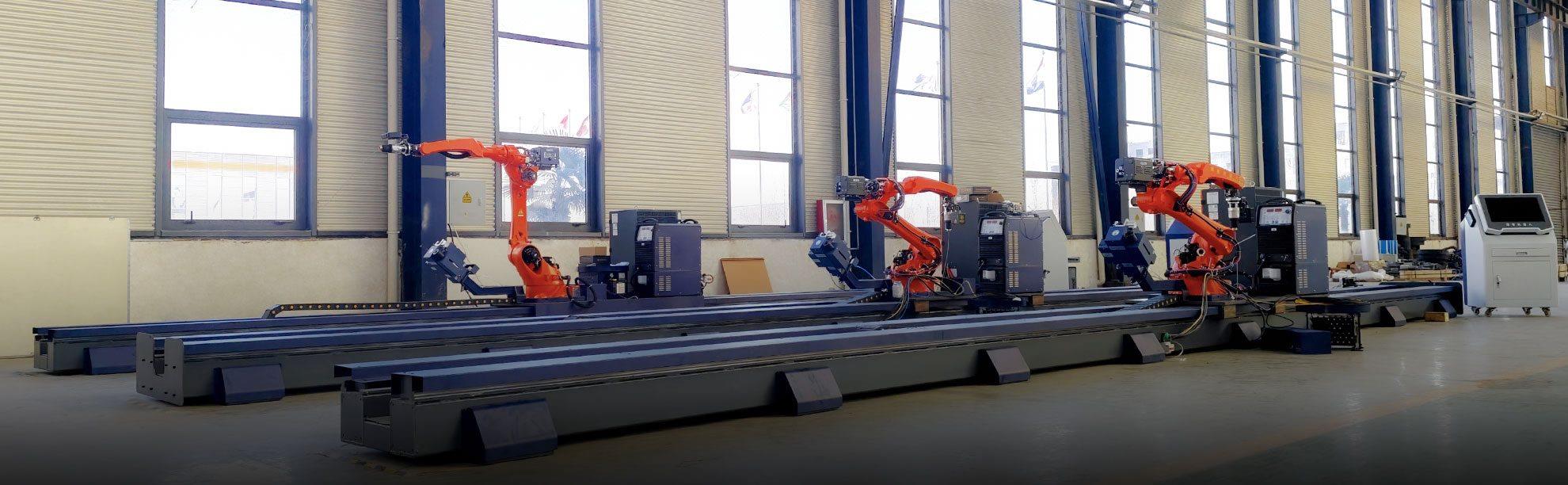
How to Match Welding Robots to Production Volume (From Small Batches to Mass Production)
Time: 2025-10-30 09:33:50
Optimizing Welding Robot Selection by Production Volume: A Strategic Framework from Low-Volume Fabrication to High-Volume Manufacturing
Selecting the optimal welding robot is not a matter of pursuing technological sophistication—it is a strategic alignment of automation capability with actual production volume, part geometry, material variability, and operational adaptability. At Junhao Robotics, we have partnered with over 200 manufacturers to implement purpose-built welding automation solutions—each precisely engineered to match throughput requirements, cycle-time targets, and long-term scalability.
The following guidance is derived from empirical deployment data across diverse industrial sectors:
| Daily Production Volume | Recommended Robot Solution | Key Features & Rationale |
|---|---|---|
| 10–50 units/day | Portable, lightweight 4–6 axis robots (e.g., Junhao JH-Mini Series) | Compact footprint with battery-assisted mobility; tool-free setup in under 15 minutes; ideal for multi-station, low-volume, high-mix environments requiring rapid reconfiguration. |
| 50–100 units/day | Modular 6-axis robotic workstations with quick-change end-effectors and integrated tooling | Equipped with rotary positioners and vision-guided seam tracking; delivers balanced flexibility and repeatability—enabling seamless transitions between part variants without full offline reprogramming. |
| 100+ units/day | Dedicated 7-axis robotic welding cells (e.g., Junhao JH-7X Pro) | Seventh axis ensures continuous torch orientation for complex 3D geometries (e.g., automotive chassis, pressure vessels); integrated PLC control, real-time laser seam tracking, and predictive maintenance protocols sustain >95% operational uptime. |
Why does production volume serve as the foundational criterion? Because automation priorities shift fundamentally across volume tiers. In low-volume operations, *agility*—not peak speed—is paramount: portable systems empower operators to reassign resources dynamically, accommodate frequent engineering changes, and support heterogeneous part families within a single shift. Conversely, high-volume manufacturing demands *process consistency*, *cycle-time minimization*, and *autonomous operation*. The seventh axis eliminates manual repositioning, reduces cycle time by up to 35%, and guarantees uniform weld penetration and bead profile across tight-tolerance assemblies.
Junhao Robotics does not offer standardized, off-the-shelf packages. Instead, we deliver application-specific engineering. For a custom metal fabricator producing 30 HVAC enclosures daily, we deployed a mobile JH-Mini system featuring offline programming and QR-coded part recognition—reducing changeover time from 45 minutes to just 3 minutes. For an EV battery pack supplier operating at 180 units per day, we designed a fully enclosed 7-axis cell with synchronized dual-positioner kinematics and AI-driven weld defect analytics—cutting post-weld inspection effort by 70%.
Ultimately, optimal robot selection begins with an objective, data-informed assessment of production volume—not marketing specifications. At Junhao, every engagement commences with a complimentary production workflow audit. Because intelligent automation is not defined by quantity—it is defined by precision: the *right* robot, deployed at the *right* scale, for the *right* application.