
All-Terrain Welding Robots: The Best Solution for Shipbuilding and Offshore Engineering
Time: 2025-03-01 10:46:13
All-Terrain Welding Robots: The Game-Changer for Shipbuilding and Offshore Engineering
Shipbuilding and offshore engineering demand precision welding under some of the most unforgiving conditions—on corroded, curved hulls; atop open-deck platforms exposed to salt spray and gale-force winds; or during sudden rain showers on coastal dry docks. Traditional robotic welders often fail here: they require flat, clean floors, climate-controlled environments, and extensive setup time—luxuries rarely available in real-world marine fabrication.
Enter Junhao’s All-Terrain Barrier-Free Welding Robots—the first industrial welding systems engineered specifically for maritime harshness. Unlike conventional robots confined to fixed rails or gantries, Junhao’s solution features a rugged, modular platform with dual mobility options: heavy-duty rubber-tracked crawlers for steep inclines (up to 30°), unstable surfaces, and wet steel decks—and high-grip pneumatic tires for faster transit across prepared yard areas. Crucially, every unit is IP67-rated: fully waterproof, corrosion-resistant, and sealed against salt-laden mist, ensuring uninterrupted operation even during coastal downpours.
The system integrates adaptive seam tracking via 3D laser vision and AI-powered path planning that dynamically adjusts to hull deformations, weld joint misalignments, and thermal distortion—common challenges in large-plate ship construction. Its lightweight yet stable chassis (under 120 kg) allows easy manual repositioning by two technicians, eliminating crane dependency and reducing downtime between work zones.
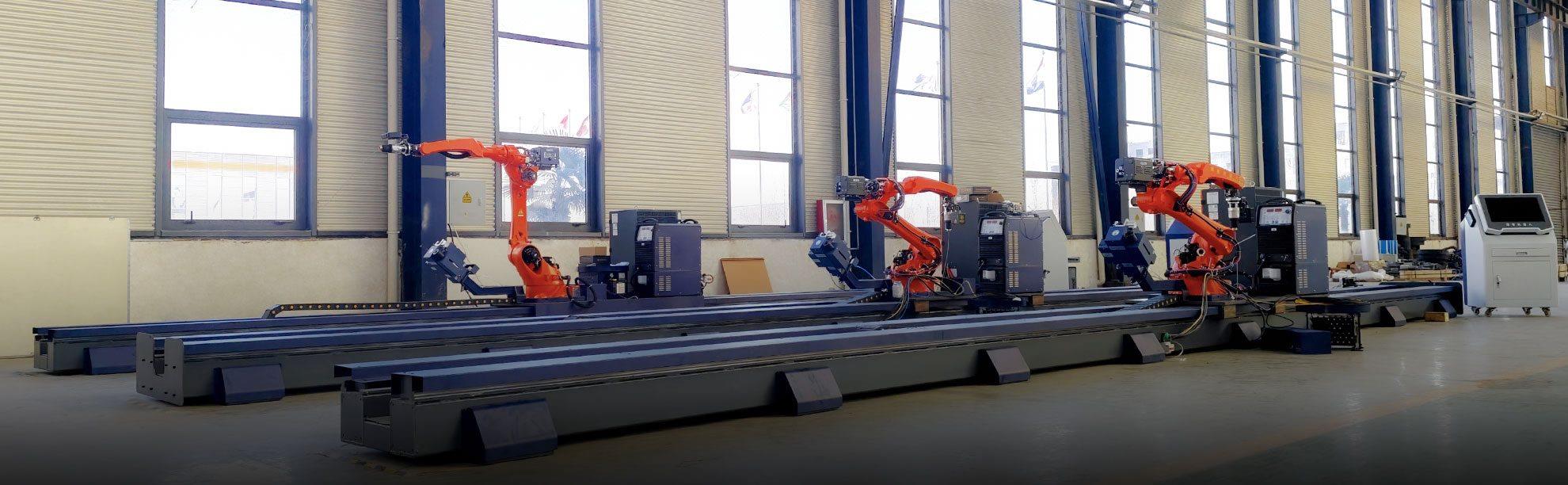
A compelling validation came from Zhejiang Coastal Shipyard, a key builder of offshore support vessels. Facing chronic delays due to manual welding bottlenecks on complex stern frames and ballast tank walls, the yard deployed three Junhao AT-Weld units in Q3 2023. Within six weeks, weld pass rates rose from 82% to 98.5%, cycle time per joint dropped by 41%, and rain-related stoppages vanished entirely—even during Typhoon Lekima’s peripheral rainfall. “These robots don’t wait for perfect weather,” noted Lead Fabrication Engineer Li Wei. “They climb, adapt, and weld—reliably.”
In an industry where schedule slippage costs $200,000+ per day and weld integrity dictates vessel safety, Junhao’s all-terrain robots aren’t just convenient—they’re mission-critical infrastructure. As shipyards accelerate digital transformation and offshore projects push into deeper, more volatile waters, barrier-free welding isn’t the future. It’s the standard—now.