
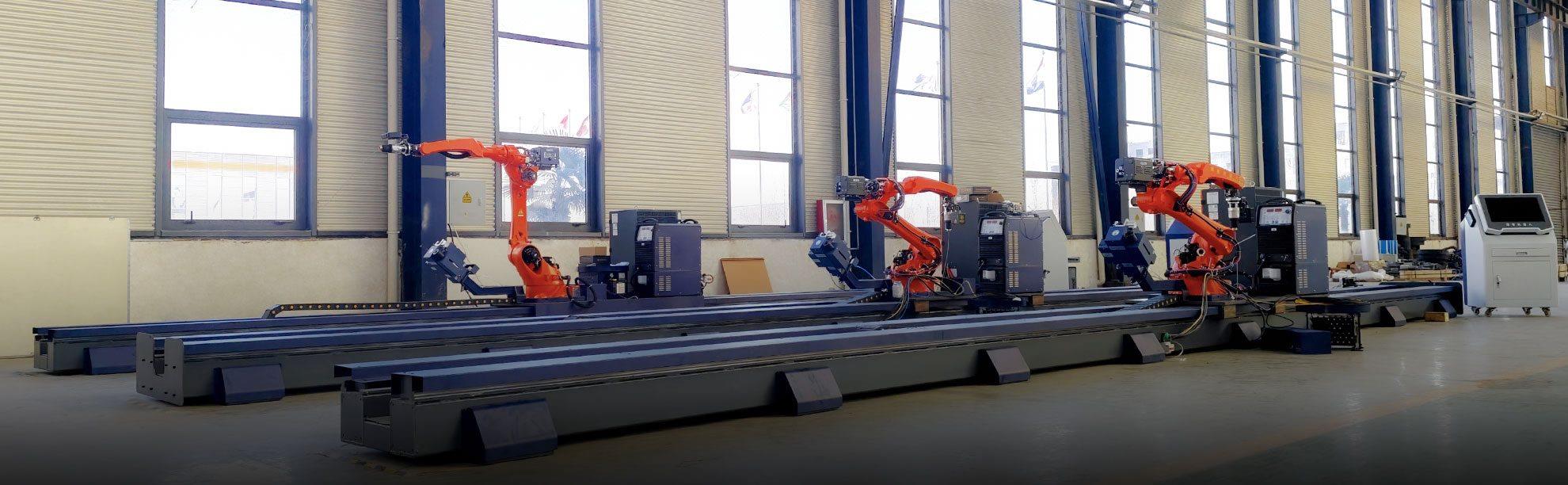
Case Study: How a Steel Structure Factory Improved Welding Efficiency with Tire-Moving Robots
Time: 2024-05-22 10:23:50
Case Study: Enhancing Welding Efficiency in a Steel Structure Manufacturing Facility through Tire-Moving Robotic Automation
A prominent steel structure manufacturing plant located in Henan Province encountered a persistent challenge in its production process: the time-consuming and labor-intensive welding of 5-meter-long steel beams. Utilizing traditional manual welding techniques, each beam required approximately eight hours to complete, leading to production bottlenecks, delayed delivery timelines, and elevated labor costs. To address these inefficiencies, the facility collaborated with Junhao Robotics to implement an advanced tire-moving robotic system designed specifically for large-scale component welding.
At the heart of this transformation was Junhao’s innovative tire-moving welding robot, engineered for high-precision applications on oversized metal structures. Unlike conventional robotic arms restricted by fixed guide rails or limited mobility, this system employs independently controlled tires that enable smooth, stable, and autonomous movement along the full length of elongated steel beams. Equipped with an adjustable speed control function, the robot delivers precise motion regulation tailored to specific weld types and material thicknesses, ensuring consistent weld quality alongside improved operational efficiency.
The integration process commenced with a two-week on-site assessment and customization phase. Junhao’s engineering team worked collaboratively with the factory’s technical personnel to optimize path planning algorithms and seamlessly incorporate the robotic system into the existing production workflow—ensuring minimal disruption to ongoing operations. Comprehensive safety protocols were established, and operators underwent rigorous training in system monitoring, routine maintenance, and emergency response procedures.
Within one month of deployment, performance outcomes surpassed initial projections. The average welding time per 5-meter beam decreased from 8 hours to just 5 hours—a 37.5% increase in productivity. This improvement was driven not only by faster travel speeds but also by the robot’s ability to maintain optimal arc stability and torch positioning throughout the entire weld trajectory, significantly reducing defects and rework associated with human error.
Moreover, operator fatigue diminished markedly as personnel transitioned from physically strenuous manual welding tasks to supervisory and monitoring roles. The facility also observed enhanced weld uniformity, contributing to superior product quality and increased customer satisfaction.
Following the success of the pilot initiative, the company plans to deploy two additional tire-moving welding robots across other production lines by year-end. Management emphasizes that automation is being leveraged not to replace skilled labor, but to augment human expertise and elevate overall operational capability.
This case exemplifies how targeted automation—particularly through mobile robotic solutions such as Junhao’s tire-moving system—can transform heavy industrial manufacturing processes. For steel structure producers facing challenges in scalability, efficiency, and quality consistency, intelligent welding robotics offer a proven pathway toward leaner, faster, and more sustainable production operations.