
Industrial 4.0 Trends: How Automated Welding Robots Boost Manufacturing Efficiency
Time: 2023-11-17 10:06:42
Industrial 4.0 Trends: How Automated Welding Robots Boost Manufacturing Efficiency
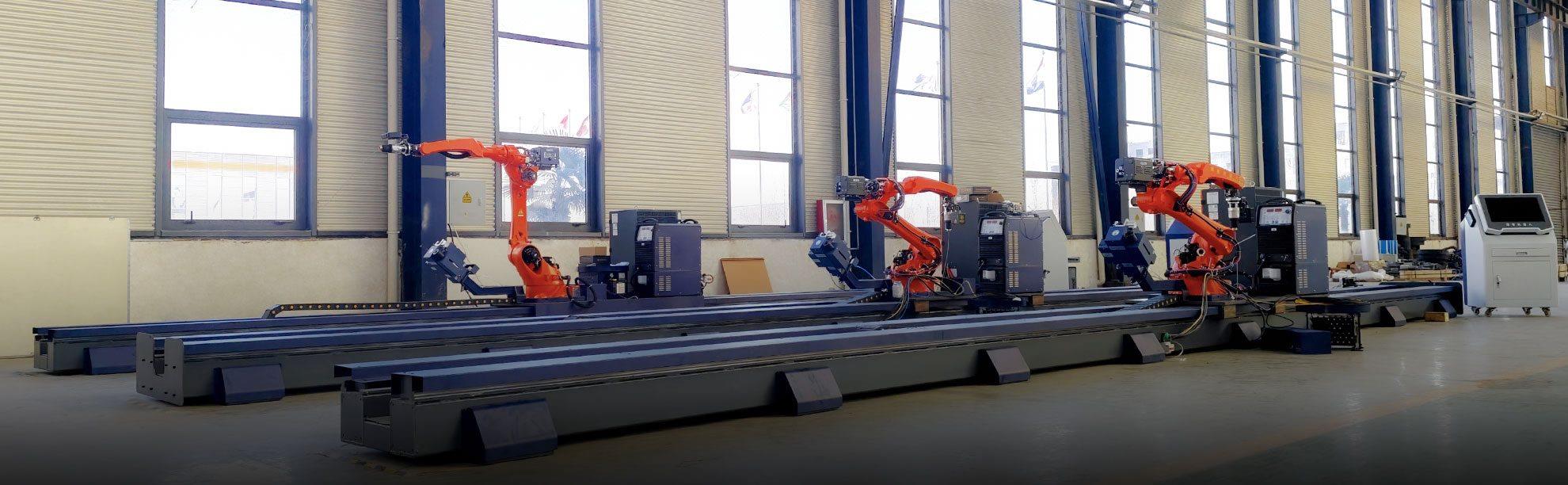
As Industry 4.0 reshapes global manufacturing, automated welding robots are no longer a luxury—they’re a strategic imperative. Moving beyond simple task replacement, today’s intelligent welding systems integrate connectivity, analytics, and adaptability to deliver unprecedented efficiency, quality, and uptime. Three pivotal trends define this evolution: data-driven welding, remote monitoring, and flexible production—and Junhao’s all-terrain intelligent welding robots exemplify how these trends converge in practice.
First, *data-driven welding* transforms weld quality from experience-based guesswork into science-backed precision. Equipped with real-time sensors and AI-powered process analytics, Junhao’s robots continuously collect parameters—arc voltage, current, travel speed, bead geometry, and thermal profiles—and feed them into cloud-based digital twins. This enables predictive optimization: algorithms adjust settings on-the-fly to compensate for material variance or joint misalignment, reducing rework by up to 40% and ensuring consistent ISO 5817-compliant welds.
Second, *remote monitoring* unlocks true operational transparency. Integrated IoT modules (LTE/5G + edge computing) allow plant managers to supervise fleets of Junhao robots from centralized dashboards—tracking KPIs like cycle time, uptime, consumable usage, and defect rates in real time. Alerts trigger automatically for anomalies (e.g., torch wear or shielding gas drop), enabling proactive maintenance. Crucially, technicians can diagnose and even push firmware updates remotely—minimizing downtime without physical presence.
Third, *flexible production* meets the demands of mass customization. Unlike traditional fixed-path robots, Junhao’s all-terrain models feature omnidirectional mobile bases, adaptive vision-guided navigation, and modular tooling. They autonomously relocate between workstations, recalibrate for new part geometries via CAD-to-path planning, and handle diverse materials—from structural steel to stainless pipelines—even in unstructured environments like shipyards or field construction sites.
Together, these capabilities enable “24/7 unattended welding”: robots operate overnight, weekends, and holidays with zero human intervention—boosting asset utilization by over 65%. For manufacturers, this means faster time-to-market, lower labor dependency, and scalable resilience. As Industrial 4.0 matures, Junhao’s integrated, IoT-native welding solutions don’t just automate welding—they redefine what intelligent, responsive, and truly autonomous manufacturing looks like.